Thursday, 7 March 2013

The 30 Day challenge - Day 30. The art of finishing.

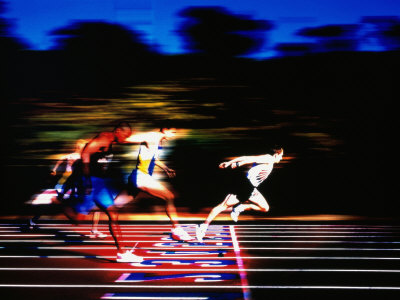
I know how he is feeling right now...
So finally! The end of the 30 day challenge is here! Only a mere 126 days overdue! Its not that long! Is it? What on Earth can you achieve in 126 days? Well, thats the amount of time it's taken me to write the last 7 blog posts for The Focused Mind! It's the amount of time the US Congress will sit in session this year! Its the length of time the Da Vinci Science Centre in Pennsylvania exhibited the Bodies Revealed exhibit to 15 million people. And apparently it's the length of time it takes to find your career (should you want one) with your humanities degree! A popular e-book it seems. :-)

Joking aside, I went into the challenge in October with the greatest of intentions and a voyage into the unknown. Initially, I was inspired by Matt Cutts TED talk where he advocated trying something new each day for a month. Equally, I'd been reading on and off the blog of Anna Dahlstrom who went way beyond my remit, and blogged each day for a whole year! (Congratulations on doing that by the way Anna!). During my blogging content explosion, former BBC R & D colleague Ian Forrester did a similar 28 day blogging challenge.

What lessons did I learn from the experience?

Fundamentally, time management (or lack of!) and how long it takes to write web content of a decent standard!

Looking back at the first post I stated I was going to:

"...set myself the small challenge of writing 30 engaging blog posts in a month"

For 23 days I did - moreorless - keep up that level of productivity. Where Ian found he was blogging more than once a day on occasion, I was having to spend more time going off and researching various sport psychology content/fact checking/verifying what was publishable, sometimes eating up hours - which I hadn't initially legislated for.

A couple of very unexpected things also happened... By doing the very researching on this blog, I was learning about topics that helped me attain a PhD post at UCLAN in Preston. That was a very profound and unexpected by-product of the blogging process!

I also had to break off from blogging whilst I was revising for my BPS Sport Psychology Chartership exams and getting ready for 2 months travel to South America. It was great to actually be able to include and blog about the race to Christ the Redeemer in Rio that I did whilst away at Christmas!

But, through updating each post via my Twitter account and putting out a call for guest bloggers to get in touch/contribute, I was able to learn about and publish on "running with will power" (Thanks Simon Freeman), find out more about what it's like to live in Kenya and train with elite athletes (thanks Ad Finn), learn more about Paleo living and diet (thanks Simon Whyatt), find out just how much music and running obsessions have in similarity (thanks Gilles Peterson), explain how great I think the Chimp Paradox concept is (thanks Steve Peters), offer practical advice on how to improve athlete mental toughness (thanks Duncan Simpson), what the secrets of top level pro cycling training are (thanks Carlos Taboas), what you need to know if you want to train for a triathlon (thanks Nick Holt), and finally, how the winning and losing margins in sport can be swung by momentum (thanks Greg Young).

The response has been enormous - re-tweets, new followers, and traffic that I hope I can retain by continuing to write about my passions for educating to those interested about sport psychology and coaching. I don't feel enough of what is taught and learnt in higher education on these subjects gets filtered down to those people who need to read about it. That is why I try and translate the academic without dumbing down, to pass on to those who will most benefit. The academics who have helped contribute over the last month have got this, but also have said that it is much tougher writing for this audience than their usual lectures and publications!

I hope that if you've taken the time to read my ramblings you have enjoyed (and learnt) something along the way. The benefit of doing this exercise is that I still have so much I want to add on to the blog. I research on eating disorders and depression in athletes. There is definitely a requirement to highlight and help in this area. There are books and films to review (Bradley Wiggins & O Zelador in particular), more guest blogs and advice to pass on.

As the picture for this post shows, maybe its not as important to come in at the desired finish time, its  more important to cross the line and finish full stop. It is a cliche I know, but taking on this challenge has definitely been as much about the journey as the destination. For now I'm going to do what is probably the most apt at this point. Close down the computer, stick on my kit and go for a run.

Thanks to all,
S
x

Wednesday, 6 March 2013

The 30 Day challenge - Day 29 - Guest post on Momentum by Greg Young PhD

Nani's sending off illustrated team psychological momentum

Today’s blog comes from a Geordie researcher currently living in Portland, Oregon. Greg Young is a Certified Consultant of the Association for Applied Sport Psychology. His specialty in research is the area of psychological momentum, specifically the athlete’s experience of when changes during a performance affect the eventual outcome. Given that Greg specializes with football and that one of the biggest games of the season (Manchester United V Real Madrid) seemingly turned on the outcome of a controversial sending off last night, this seems a particularly pertinent post!

I’ll leave it to Greg to introduce what Momentum is, what research has so far elucidated on the subject and some tips if an event is not going your way. If after reading this you have more questions or points to make, then please ask away in the comments section. If you want to contact Greg directly, he can be reached via Twitter
@docyoungy.

Greg: Thanks Stuart! Momentum is one of the most often cited yet least understood phenomena in sport.  Commentators and pundits talk about it swinging or changing in an instant and in terms that make it sound like a baton being passed between players and teams.  Although theories of momentum already exist (see Cornelius, Silva, Conroy, & Peterson, 1997; Taylor, & Demick, 1994; and Vallerand, et al., 1988) a universal definition of momentum does not currently exist.  Therefore, trying to understand exactly how momentum works is a lot like trying to nail water to the wall; you bang away with the hammer but ultimately nothing really sticks.  So let the hammering commence…

Before we delve to deeply into the topic, let me start by saying momentum doesn't exist…statistically anyway.  Early definitions from social psychology referred to momentum as a bi-directional concept, affecting the probability of winning or losing as a function of the preceding event (Adler, 1981).  Research examining data from actual competition has shown performance that followed previous successes or failures to be no different than would be expected by chance (e.g., Gayton & Very, 1993; Koehler & Conley, 2003; Silva, Hardy, & Crace, 1988).  This is how momentum has been defined in the past and perhaps the way that many people conceptualise the phenomena - being on either a positive or negative “roll” as it were.  Although there is not currently a universally agreed upon definition of momentum, recent definitions of momentum have included a psychological component describing “changes in an athlete’s performance based on success and failure in recent events that have in some way changed the psychology of the athlete” (e.g. Vergin, 2000).  That is to say that the athlete perceives the situation to carry meaning based on recent events, which causes them to think and behave differently.

With the addition of the athlete’s psychology in mind, we can now take into account perceptions of momentum, that is to say how do they think momentum influences their performance.  While perceptions are very difficult to quantify, they undoubtedly impact behavior if athletes believe it does.  I have been lucky enough to interview high-level tennis, football, basketball, and volleyball players about how they perceive and experience momentum in their sports. The following information arises as the pertinent results from those interviews. While these sports may not exactly mirror the overall emphasis of this blog I am sure you, as athletes and coaches looking to improve your craft, can find parallels.

Athletes I have worked with are acutely aware of “knowing” when and how they are experiencing momentum.  Most commonly we associate momentum with a score line or objective measure of success and failure.  While these are very powerful indicators of momentum for athletes they are not the be all and end all.  Other aspects that are much harder for us to observe, as they don't necessarily manifest themselves in objective success, occur within the athlete themselves.  These include both physiological aspects, such as increased adrenaline and energy levels (feeling bouncy) or feeling relaxed and smooth during performance, and psychological aspects such as increased confidence or feelings of being unstoppable or invincible! For example, I was lucky enough to discuss momentum with a professional tennis player.  He continually mentioned how he saw I as something very important in tennis: “momentum makes you just play freely and makes you relax.  I know sometimes I’m playing so relaxed I feel I’m not even holding the racquet, it’s just in my hand, it’s stuck to my hand with sticky tape, that’s how loose it is”.  While this feeling of relaxation and other internal thoughts, feelings, and emotions may not be as explicit as a score line or a time on a watch, they are equally valuable to athletes as indicators of momentum and can often contradict what appears on the scoreboard.  Simply because we do not see success in terms of goals, points, or splits, does not necessarily mean we don't have/are experiencing negative momentum.  Checking in and assessing how we’re doing with these internal factors can help facilitate positive perceptions of momentum, even if the score line/time/split/placing in the field may suggest otherwise.

We often consider momentum something that changes in the blink of an eye caused by a specific incident.  For example, Nani’s surprising sending off in last night’s Manchester United vs. Real Madrid Champions League match was without a doubt the critical moment in the game in which the momentum of the game changed and Madrid took control and dictated play at their own pace despite being a goal behind.  However, athletes also see momentum as something they can systematically build, without relying on some magical switch to be flicked or some “Unbelievable, Jeff!” incident to occur.  

In my research, building one’s own momentum was described as being more powerful and resilient than momentum “given” to us by an opponent or caused by a single moment.  Athlete’s I have worked with described how they build their own perceptions of momentum by using some the following techniques:

·    Get off to a good start – build an early foundation of success on which to continue to develop your momentum
·    Find a balance for your effort and play within your capabilities – don't try to force a “big moment” to happen.
·    Go back to basics – play simply and concentrate on components that have brought you success in the past.
·    Control the rhythm and tempo of the event or the game - dictate the pace you want, no one else’s
·    Trust your preparation and execute your plan – You have the plan for a reason, you designed it to be successful, follow it!

It should also be said that these are simply good practice for all performances and tie into the use of a process focus for successful performance (Stu has written previously on this topic on process goals for marathon running).

One final thought to leave you with… Consider the way a crowd reacts at a sporting event. The athlete is not directly trying to make the crowd react, but rather influencing his/her performance that in turn dictates the reaction of the spectators. The same can be said for momentum, as athletes are generally aware of momentum in their performance but are not focusing on trying to influence it directly. Rather athletes attempt to positively influence their performance, which in turn has a positive impact on their perceptions of momentum.

In conclusion, if you take care of the process and do what you need to do to be successful during performance (and avoid being sent off!) you don't have to worry
about finding momentum, it will find you.


Sunday, 3 March 2013

The 30 Day challenge - Day 28 - Competitive race training (in praise of Park runs)

The lake at Delamere that the 5k Park Run course follows
Having spent February building up mileage for half marathon training, I've spent the past 2 Saturdays completing 5km Park runs for the first time, last weekend in South Manchester and yesterday in the inaugural Delamere Forest Park run.

Having friends who have participated previously who advised they're a great place to measure progress on your speed work, I nervously gave these weekly gatherings a go.  From a standing start having taken 3 months off from track work, the races have been hard going and tougher than I imagined. I'm about 2 minutes off my 3 mile PB from 2 years ago. But progress has already been noticed, and with some track sessions, a bit of pacing and a fair wind, I'm confident that by Easter I should be knocking on that  PB.

What's pleasing about the Park runs is seeing so many people out pushing themselves for their own reasons. At the top end of the stack there are some seriously good athletes (in the 16 minute finish category), all the way down to run/walkers completing and competing in their first organised event. And you know what? I love seeing it. The unrelenting media misery of double, triple dip recessions, bad news, high obesity prevalence and how much this costs the overburdened tax payer would leave one thinking that improving ones health through something as egalitarian and inclusive as Park run would provide good headlines.

Maybe I'm just soft, but something warms my cockles seeing 250 people turn up on a miserable winters day in a South Manchester Park, all pushing themselves to finish, with their own running stories. But hearing a programme on Radio 4 this week, and looking online, it seems that some in the UK running community feel threatened by the presence of 280,000+ souls per week partaking in the the Park races. Their complaint is that unlike organised club events and commercial races, UKA is missing out on potential revenue and club numbers will be affected as new runners bypass the club system just to do park runs and enter the odd race of their choosing.

As ever where the old brigade of the running community is concerned, they miss the point that when you talk to people partaking in Park Runs, a huge number come from clubs, intend to join clubs or give up their own time to marshall/ensure public safety. From my perspective, Park runs are a great shot in the arm for UK Athletics, and club running. They are, if you like, a gateway drug.

Some participate in the 5k's to kickstart their running journey, eventually signing up for 10ks, half-marathons and beyond. When I heard that people were complaining about Park runs, I banged my head against the (metaphorical) wall. Along with Triathlon, distance running is the largest growing participation activity (numbers wise) in the UK and this should be something that should be applauded. If UKA have issues with regard to Park Run and funding, that isn't something I can't really comment on and have to leave to those respective parties.

Off the record, I've heard some top end coaches complain that the effect of so many extra participants in UK running is diluting the quality at the top end and overall, for a number of factors, the amount of club runners clocking fast times and PBs has been decreasing over the past 50 years. You can't argue with statistics, and I do accept that the amount of top end runners (based on time) has gone down. But rather than sit on the sidelines and snipe, why don't those naysayers go and encourage the cream of Park runners and develop them?

Maybe I'm missing the point - if you're someone who has an issue with Park runs and want to explain what needs changing, then I'm open to hearing why. For the record, I do intend to run more park runs but also have entered (and paid for) 1 10K race this month and 2 half marathons in the next two months. Without overdoing the amount of races, if coaches want to see improvements in their athletes, I do think that participating frequently in races is a great proven way to up those times at the top end. From the 5k to the full distance.

Friday, 1 March 2013

The 30 day challenge - Day 27 - The Psychology of coaching Pro cyclists

This blog post is a little late in publication but was recorded prior to my visit to South America in November. Now that I have been researching in detail the clinical aspects of cycling (eating disorders, their symptoms and the psychological effects this has on riders), it seems an apt time to finally publish this piece. For the reasons stated I've been playing catch up since my return, but it gives me great pleasure to introduce on camera my good friend Carlos Taboas Lorenzo, who guest posted a few years ago on team mental toughness within professional cycling, which he completed for his MSc thesis.

Since graduating, Carlos has moved on to be a coach and performance trainer with a number of cyclists of different ability levels both here and in Spain. In the video he discusses his experience first as a rider (winning the 1988 Tour of Ibiza and the Spanish championship at 17 years old). He then mentions how he joined the elite for a number of years before having his career ended before it hits its peak.

Moving sideways professionally, he re-trained in sport science, specialising in Sport Psychology at MSc level, to be able to assist on the other side of the professional relationship.

Cutting to the chase, I ask what he does now for cyclists and how that differs to what he experienced when he competed as a pro cyclist. Fundamentally, he emphasises getting his athletes to enjoy their training. As an athlete he worked hard but lost the enjoyment factor and somewhat fell out of love with his sport for a time. He tries to get his riders to understand what they like about training and change things if necessary and believes it is this emphasis that keeps his riders motivated.

He tailors his work on a 1 to 1 basis with each rider, even in the off season, finding alternative core training that they might like and avoiding where possible training they like less. In his time on the pro circuit he was prescribed training by coaches that he didn't enjoy; didn't fully work out goals with coaches and subsequently put too much pressure on himself to succeed.

The impact on his riders is that they have improved performance wise (so far) in both time trials, training, ranking and in the feedback they give him.

He believes having a sound relationship between rider and coach is crucial. This follows the work by Sophia Jowett at Loughborough that identifies one of the most important elements that plays a role in success for an athlete's well being and performance comes from the relationship between the coach and the athlete (and indeed from all of the significant people around an individual). Think of the closeness of Tony Minichello and Jessica Ennis or Alberto Salazar and Mo Farah and the importance of the relationship between coach and athlete on the athletes well being and performance. Research has also shown the deleterious effect of a bad relationship, ranging from physical and mental abuse to less negative factors that impact athletes at all levels. More can be read in this paper from 2003 on Olympic athletes, which has lead to guidelines being given to those involved within sport to follow.

I then asked Carlos for advice on psychological training for endurance athletes. He advocates a self-assessment of how much you are enjoying your discipline, not overtraining, taking plenty of rest (see some great advice on this subject from Simon Freeman this week from his blog. If you're an endurance athlete training over 5 times a week you should be getting at least 8 hours solid sleep a night to allow for proper repair to your body), and learn (or re-learn) how best you yourself enjoy your discipline. When you're a slave to the schedule, it is easy to fall out of love with what you are doing.

With the benefit of reflection, whether you're self-trained or have your own coach, it is easy to lose sight of why you are pushing yourself so hard. Just to get a time? To get a PB? Think ahead, both to your upcoming training, competition and the off season, and see how you can make your workouts more fun. It should have the impact on your both your fitness and level of motivation.

Thanks Carlos!

Wednesday, 23 January 2013

The 30 day challenge - Day 26. So you want to do a triathlon?

Further to my post on Monday, where I advocated trying different kinds of training or exercise in order to keep motivation for your main discipline up, a question I've had asked many times when people find out I run, is "Have you ever done/would you want to do a triathlon?"
For years I would say, "I like all 3 disciplines, just not all at once thanks," but now I'm thinking about tipping my toe in the triathlon water - just a sprint one mind - and wanted to know a bit more. Talking with other endurance runners, it turns out quite a few have given triathlons a go having done a marathon or two.
One of the biggest advocates I know from the triathlon camp is Nick Holt (@nickersan on Twitter) who I know through my visits to Run Dem Crew. On holiday in France last year, he managed to convince my girlfriend to give tri a go, and in 2013, it looks like I *might* be following in his footsteps. Nick speaks so passionately (perhaps even obsessively sometimes!), we tapped him up for loads of advice, which he was more than willing to share!

So I asked him, for us runners, can you give us some idea of what we may be letting ourselves in for? What is it like? and What do you need to get through a tri, both physically and mentally? Luckily, Nick has been kind enough to pass on a beginners guide, which is what makes up today's post. I hope this helps, and if you have any of your own tips or advice, please leave below in the comments. Over to you Nick!

Nick: Thanks Stu.
The triathlon is a surprising event - on their own, none of the three disciplines should offer that great a challenge but put them back to back and the triathlon will test even the fittest.  In contrast to single discipline events like the marathon, there are some tricks and tips in how each discipline is approached and the transition between them that will ease the journey from start to finish.
Before you start you’ll lay out your kit in the transition area.  No rocket science here, during the race you want to be in and out in as short a time as possible.  Your bike helmet should be unbuckled, shoes ready to slip on and it helps to have a bright towel or similar marker on the floor so you can spot your things amongst everyone else’s.
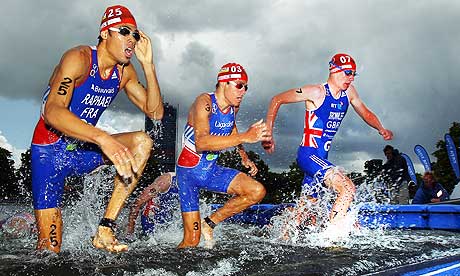
First off is a 1500m swim.  Nothing too demanding in the comfort of a heated swimming pool, but in the triathlon the swim is typically in open water.  Unlike the pool, there are no ends to rest at as you turn every 25m, you can't see much further than your forearms and if you compete in the UK the water is cold – imagine training for a marathon on a treadmill only to be faced with a typhoon come race day.  It's this cold water that's the first thing you notice and something you can't do much about other than letting your body acclimatize.  So you need to be thinking as soon as you take the plunge - let the water run into your wetsuit, get head fully submerged and relax your breathing ready for the starter horn.  Once underway focus on smooth steady strokes and relaxed breathing while not being too obsessive about the one, two, three breath stroke pattern you’ll have got used in the pool.  Also pay careful attention not to drift off course - something easily done without the familiar confines of a pool – by sighting on buoys that mark the course.  And in no time the finish will be in sight.  With about 100m to go it’s time to start preparing for the first transition.  Unlike a single discipline event where you can collapse over the line, you have to focus on what the change will bring.  The swim is mostly upper body and so that’s where the blood will be – getting out the water like that and you’ll be dizzy and wobbling about like a drunk on New Year - so start increase the kick in your legs to try to get some blood into them ready to sprint into transition straight from the water.
In transition it’s wetsuit off, helmet on (shoes too depending whether you pre-clip them or not) and out the door with your bike.  Some baby oil around the ankles and cuffs of the wetsuit when you first put it on will help with the prior and having laid out your kit well the later.
The bike stage is 40km, the longest discipline in both distance and time.  In comparison to the surprise of the swim, the bike is actually easier than in training – you’ve got the road to yourself, well you and those competing with you, so all you have to do is keep you head down, pump your legs and settle into a rhythm.  The comparative tranquillity of the bike make it a good place to take on liquids or gels so that you can hit the next leg, the run, full throttle.
But before the run, there’s another transition.  Much simpler this time, off with your helmet and bike shoes and on with your trainers.  The hard bit is that after an hour or so of cycling your legs will feel like jelly as you switch from using your upper leg muscles to the lower.  There’s no getting away from this, which is why it’s so important to have incorporated bike/run brick sessions into your training – they’re just what they say on the tin - you do a bike session and go straight from the bike to a run session, just like you do during the triathlon.
Legs aside, it’s just now just a 10km run between you and the finish line.  Over the first km your legs get back to feeling how they should and you can relax into the run.  In fact the run always feels shorter than a 10km road race to me, probably because I know the end is in sight – no scrambling about in the water trying to swim in a large group or punctures to worry about.  In fact the bit that I find the most difficult is counting the laps, something I wish I had a trick for but I don’t.  You just have to maintain the concentration, though I always finish the race and spend the time between then and the results being published worrying that I’ve done one lap too few – it hasn’t happened yet.
So overall, the triathlon is so much more than the three disciplines.  Doing each back-to-back introduces extra physical and mental challenges whether it’s the unfamiliar stresses and surroundings of an open water swim, the slog and time for reflection on the bike or the tired push to the finish for what should be an easy run, but is anything but.  However in some ways doing three disciplines also has its benefits.  Like any event you need the determination to get to the finish, but unlike a marathon where if you’re not feeling good at half way you have to grit your teeth and deal with it, in the triathlon if you have a bad swim you know you’ve got chances to catch up during the next two disciplines.  Likewise on the bike there’s always that little 10km to make up some time and if it all goes to pop during the run, well you know it’ll soon be over and there’s always next season.
However a word of warning, triathlons are surprisingly addictive.  Training for three disciplines introduces a wonderful variation to your schedule with each discipline feeding positively back into the others – in short I can’t recommend trying (pun intended) one highly enough.

Monday, 21 January 2013

The 30 day challenge - Day 25. Getting going...

Psst... Want to know something I've only just realised? Till this weekend, over the last 2 months whilst I was travelling, I ran just twice. Having been running every winter for the past 6 years, in all conditions, whilst away I didn't do much. Partly it was circumstance. In some places running was less feasible - either through the terrain or unsafe (I'm thinking about the traffic, neighbourhoods and tarmac in the likes of Bogota and Arequipa). In other instances, I just couldn't be bothered. I packed the trainers and kit but I was tired of running. This wasn't to say I gave up exercising completely. In Colombia, Anna and I went on a 2 day mountain biking break. Many miles and tough terrain were completed. In Peru we did 3 quite long and tough treks in a month. And then in Rio we did get some running mojo back - completing the toughest race I've done in a while, the amazing run from Lapa to Corcavado to Christ the Redeemer. My second run on holiday was the recovery run the next day.

After that, I wanted rest before returning to start a PhD at UCLAN, so running got the boot! In all honesty, its been nice to take a break and recharge the batteries, without the nag of the next run looming. In 2012 I probably ran on more days than any other year, so a rest was welcomed. It was really fun to mix up the exercise on our trip by doing more trekking.

So back to the UK and I've just started venturing out, slightly wary about running again after such a long break and negotiating the ice and snow. I'm reminded of Cross country's I used to compete in for Victoria Park Harriers in London. Some mighty muddy and cold races were completed in various (and  obscure) parts of London. However bad the runs were, the camaradarie of the experience with your club colleagues (and often a flask of tea and homemade flapjack at the finish) made the activity more bearable and fun.

Anyway, enough moaning. I'm adjusted back to the brisk British weather, have been out twice in the past three days I'm over my lethargy. Though today's 7 and a half miler was a challenge to grit the teeth through, it was definitely better to go through the experience, chalk it up and acknowledge that the conditions will get better in the next month and after getting the mojo back in action, each run will feel easier. It's easy to lose heart and motivation sometimes, but I do think a change is as good as a rest. A well deserved sabbatical from running is good for both the legs and the soul. Or changing discipline slightly, whether upping your core, looking to do different races or training (Simon Freeman's post on off road running is a good example), or a different discipline for a while. Finishing the run was a reminder of that great feeling that you've succeeded though. On my Garmin account I called the run 'In your face snow and Monday morning' - I think that sums up the feeling!

Now that I'm back, I've also got the last 5 posts of my 30 day challenge to upload. As well as having a sabbatical from running, I also took a sabbatical from blogging. I was on me holidays ok?! ;-)
These will be all going up before too long. Belated happy new year to all. I hope you have enough variety in your training to keep your motivation up and that you hit your goals and PBs in 2013!

Sunday, 30 December 2012

The 30 day challenge - Day 24. Cristo Redontor race, Rio. December 2012

With our medals at Cristo Redonter
So, a long time since I last posted any blog content. Since October I have been preparing for and then travelling in Colombia, Peru and Bolivia before we got to Brazil a week ago. Whilst en route I was in touch with Charlie Dark of London's Run Dem Crew about trying to hook up with some Rio runners. Luckily he had been over in Rio earlier in the year and made contact with 2 running groups. Charles Silva of Coletivo Briza got in touch and emailed me whilst in Colombia suggesting we join him and his group of friends who run with Nike Coisadaboa in Copacabana every Saturday. He challenged Anna and I to try the annual race from Lapa to Christ the Redeemer, the highest point overlooking the city, which 500 runners (or nutters, depending on your point of view) take part in. The route is 12 KM and run in the early morning to at least make it more a little more bearable from the scorching Rio heat. Having chatted with Anna about whether we wanted to put ourselves to the challenge whilst on holiday, we decided it was too good an opportunity to miss. Having also hiked a lot at altitude in Peru, we thought if we hadn't run for a month, we would have a little advantage at sea level running uphill! Deep down we were both nervous and not sure of how our fitness would help or hinder in much different conditions than we were both used to.

Getting up early we went to the famous Lapa arches to meet Charles for the first time and prepare to race. Wearing my VPH colours with my name on my vest stuck me out from the crowd so Charles could find us. The race organisation was much different from English races. People were given their numbers from one guy half an hour before race start and runners were still milling around without a clear indication of where the start line was. Luckily we were stood in the right place and before everyone properly gathered, some keen runners moved to under the arches and started the race in the direction of Santa Theresa! We were still chatting to Charles friends from the Nike club when we saw the lead party go so joined the throng to make sure we would be able to follow the route.

At first we turned up a hill on a cobbled street and got used to the race pace. For anyone in the UK has run in the Hastings half marathon, the hills at this point, for the first 4 or 5 Kilometres were about as challenging as in the Hastings race. A little testing, but nothing too hard. Once past the suburb of Santa Theresa the route flattened out as you looked down to the East of the city, climbing along a hill edge  shielded by forest on either side. As you saw down to the city through the trees, you were nicely shielded from the sun which was beginning to burn brighter (it was about 9.30 by now).

The humidity made it sticky and my vest was already baked to me in a lovely clammy manner. I was thirsty despite having quaffed a litre of water just before the start. Luckily 2 drinks stations meant we didn't suffer too much. I found my pace and followed Charles instructions to go easy on the hills, and then accelerate on the flat. I didn't have my Garmin as Anna borrowed it for the race, but I could see from my wristwatch my rough time. I was using Charles PB of 1 hour 15 from the previous year as a guide to try and aim towards. Everyone had said that the last 2 miles were the worst so I tried to conserve some energy for a big push to the end without going too fast. With no mile markers though, I was running blind (as it were), but pleased with my efforts, not feeling too exhausted. We got to a point where the road turned into the national park entrance to let buses up to the Christ statue, and I foolishly thought that might be the 10KM point.... Things still felt good, so I pushed on, awaiting the gradient to really start.

I'd kept my place in the race with the odd runner overtaking once past Santa Theresa, and I did nick the odd place back myself. Then the hills REALLY started. I slowed but aimed to keep going up the hills slowly, just faster than walking pace. I guess I managed to keep this up for half a KM, then it was so steep I could barely run, so walked 20 metres or so, got my breath back and then even slower got the 'running' going again. Tiredness bit again. I walked 20 metres, then ran, then walked, and then I thought, "Sod this. I'm going to keep running, even if it is snails pace," zipped up my man suit and dug in. The steepness was unrelenting. I had no idea whether it was 2km or 5. I kept catching a glimpse of Jesus, and he seemed to be getting nearer. I knew it wasn't too much further. I kept up with a couple who were just a bit quicker than me. We passed another water station. Not much further surely?

Then we hit what I could tell would be the final leg. I saw my watch. I'd be running over hour and thought I'd be lucky to be near Charles time from 2011. I turned one more bend, Jesus was much nearer. Some fast finishers with medals were jogging back down the hill past me. I kept going. Turned a bend, saw the finish and found one last push. There was no finish line! Just a guy giving out medals,  another giving out water, and another fruit. I couldn't see the compadres from Charles group. I couldn't believe it. I'd kept my pace from the start and looked at my wristwatch. 1 hour 15 minutes. I'd done it. Stripped off the vest, put on my medal and waited for Anna and the crew to come also finish.

Chico Aguia and us at the finish
Our favourite finisher, Chico Aguia, a veteran legend of Rio (see left), of 72 years came round the finish bend with another runner five minutes after me, crossing the line with a Brazilian flag. All of the finishers cheered loudly, and he did 10 press ups to show he wasn't done just yet!

It was a fantastic race, one that I feel very privileged to have competed in (and completed!) and we chatted all the way to the statue and back home to our new found Brazilian running crew. If you get the chance you have to do this race - the first Saturday after Christmas, then I have no hesitation in recommending it. The view as you'll see below, is worth all that effort by the end. I would say in its own way, its as challenging as a marathon for the reserves of mental fortitude that are required, particularly if you're from Northern Europe!

Thanks Charles and all of the Coisadoaba Nike team.