Sunday, 30 December 2012

The 30 day challenge - Day 24. Cristo Redontor race, Rio. December 2012

With our medals at Cristo Redonter
So, a long time since I last posted any blog content. Since October I have been preparing for and then travelling in Colombia, Peru and Bolivia before we got to Brazil a week ago. Whilst en route I was in touch with Charlie Dark of London's Run Dem Crew about trying to hook up with some Rio runners. Luckily he had been over in Rio earlier in the year and made contact with 2 running groups. Charles Silva of Coletivo Briza got in touch and emailed me whilst in Colombia suggesting we join him and his group of friends who run with Nike Coisadaboa in Copacabana every Saturday. He challenged Anna and I to try the annual race from Lapa to Christ the Redeemer, the highest point overlooking the city, which 500 runners (or nutters, depending on your point of view) take part in. The route is 12 KM and run in the early morning to at least make it more a little more bearable from the scorching Rio heat. Having chatted with Anna about whether we wanted to put ourselves to the challenge whilst on holiday, we decided it was too good an opportunity to miss. Having also hiked a lot at altitude in Peru, we thought if we hadn't run for a month, we would have a little advantage at sea level running uphill! Deep down we were both nervous and not sure of how our fitness would help or hinder in much different conditions than we were both used to.

Getting up early we went to the famous Lapa arches to meet Charles for the first time and prepare to race. Wearing my VPH colours with my name on my vest stuck me out from the crowd so Charles could find us. The race organisation was much different from English races. People were given their numbers from one guy half an hour before race start and runners were still milling around without a clear indication of where the start line was. Luckily we were stood in the right place and before everyone properly gathered, some keen runners moved to under the arches and started the race in the direction of Santa Theresa! We were still chatting to Charles friends from the Nike club when we saw the lead party go so joined the throng to make sure we would be able to follow the route.

At first we turned up a hill on a cobbled street and got used to the race pace. For anyone in the UK has run in the Hastings half marathon, the hills at this point, for the first 4 or 5 Kilometres were about as challenging as in the Hastings race. A little testing, but nothing too hard. Once past the suburb of Santa Theresa the route flattened out as you looked down to the East of the city, climbing along a hill edge  shielded by forest on either side. As you saw down to the city through the trees, you were nicely shielded from the sun which was beginning to burn brighter (it was about 9.30 by now).

The humidity made it sticky and my vest was already baked to me in a lovely clammy manner. I was thirsty despite having quaffed a litre of water just before the start. Luckily 2 drinks stations meant we didn't suffer too much. I found my pace and followed Charles instructions to go easy on the hills, and then accelerate on the flat. I didn't have my Garmin as Anna borrowed it for the race, but I could see from my wristwatch my rough time. I was using Charles PB of 1 hour 15 from the previous year as a guide to try and aim towards. Everyone had said that the last 2 miles were the worst so I tried to conserve some energy for a big push to the end without going too fast. With no mile markers though, I was running blind (as it were), but pleased with my efforts, not feeling too exhausted. We got to a point where the road turned into the national park entrance to let buses up to the Christ statue, and I foolishly thought that might be the 10KM point.... Things still felt good, so I pushed on, awaiting the gradient to really start.

I'd kept my place in the race with the odd runner overtaking once past Santa Theresa, and I did nick the odd place back myself. Then the hills REALLY started. I slowed but aimed to keep going up the hills slowly, just faster than walking pace. I guess I managed to keep this up for half a KM, then it was so steep I could barely run, so walked 20 metres or so, got my breath back and then even slower got the 'running' going again. Tiredness bit again. I walked 20 metres, then ran, then walked, and then I thought, "Sod this. I'm going to keep running, even if it is snails pace," zipped up my man suit and dug in. The steepness was unrelenting. I had no idea whether it was 2km or 5. I kept catching a glimpse of Jesus, and he seemed to be getting nearer. I knew it wasn't too much further. I kept up with a couple who were just a bit quicker than me. We passed another water station. Not much further surely?

Then we hit what I could tell would be the final leg. I saw my watch. I'd be running over hour and thought I'd be lucky to be near Charles time from 2011. I turned one more bend, Jesus was much nearer. Some fast finishers with medals were jogging back down the hill past me. I kept going. Turned a bend, saw the finish and found one last push. There was no finish line! Just a guy giving out medals,  another giving out water, and another fruit. I couldn't see the compadres from Charles group. I couldn't believe it. I'd kept my pace from the start and looked at my wristwatch. 1 hour 15 minutes. I'd done it. Stripped off the vest, put on my medal and waited for Anna and the crew to come also finish.

Chico Aguia and us at the finish
Our favourite finisher, Chico Aguia, a veteran legend of Rio (see left), of 72 years came round the finish bend with another runner five minutes after me, crossing the line with a Brazilian flag. All of the finishers cheered loudly, and he did 10 press ups to show he wasn't done just yet!

It was a fantastic race, one that I feel very privileged to have competed in (and completed!) and we chatted all the way to the statue and back home to our new found Brazilian running crew. If you get the chance you have to do this race - the first Saturday after Christmas, then I have no hesitation in recommending it. The view as you'll see below, is worth all that effort by the end. I would say in its own way, its as challenging as a marathon for the reserves of mental fortitude that are required, particularly if you're from Northern Europe!

Thanks Charles and all of the Coisadoaba Nike team.

Wednesday, 31 October 2012

The 30 day challenge - Day 23. Barefoot running on sand

So I've got to the end of October I'm down on my challenge per day on the blog. Coming up with rich content, rather than shorter posts on a per day basis is hard! Previously I've tracked my progress on marathon training and thats not so bad as you can be brief. That said, I've managed 23 in 31 days so far, with my main focus in the past week being an assignment I've got to get done by the 7th of November. So, as I'm waiting on a few guest blogs still and I value quality over quantity, I'm going to make today my last blog for a week, then complete the last 7 of the challenge between the 7th and the 14th of November. We've got some good content due, on the phenomenon of momentum, an interview with a pro cyclist and more sport psych and training insight.

As I mentioned in my post a couple of days ago, I got myself fired up by finishing a lethargic run by kicking off my shoes and running barefoot along the beach in Alicante last Friday. As a coach and keen runner, I often get asked about the benefits of training barefoot, as it is seen as very appealing to some. It is seen as being in tune with our ancestors and good for a number of reasons. Some hope to see performance improvements, as it is thought that running on your mid or forefoot propels you forward quicker. For some it is to take the pressure off knee joints/suffering chronic injuries due to the pounding on pavements and concrete (through modern stiffer support shoes). Such proponents believe we're doing ourselves more harm wearing a modern shoe than the likes of our ancestors did running with no support.

Personally, I was keen to see whether I can do anything to improve my arches and ultimately just wear flatter shoes at the track and in races, so wanted to test out what it felt like running on compact sand along a good, clean beach. Playa Muchavista affords such an opportunity a few miles out from Alicante town centre near my parents house. To me, the biggest benefit was actually psychological. To know that I was going to do a new, slow run that would be just different, with no ambition to make a commitment to joining (or not joining!) the barefoot brigade got me excited to run along the shoreline. And sometimes, you just need to change your running routine.

Having attended a training day back in May with Terri Knight at Primal Fitness in Manchester to work at some of my technique, and talked to Simon Whyatt about the benefits of barefoot running, I am more keen to make myself efficient, using whichever appropriate techniques can help my performance. Whilst I liked the feeling of running barefoot along the beach and can see myself running around a park barefoot, personally I like wearing standard runners (Nike Triax work best for me) on long runs and on the pavement. That said, having recently trained on the new track at Mile End with my VPH colleagues, I am going to buy some race shoes that I can wear for intervals and races. To get the most out of these I think it's important to prepare my feet accordingly, so when possible I will run barefoot at the beach and on appropriate terrain. As the review of barefoot running on wikipedia states:

"Scientific research into the practice of running barefoot has not reached a clear consensus regarding its risks or its benefits."

As an evidence based practitioner (and former employee of the London Marathon Store where I tested feet of all shapes and sizes), I would say I'm definitely not a full advocate of the barefoot phenomenon. There are definitely people I know who I would fear seeing wearing flats or barefoot running shoes, as there are those who have beautiful arches and really suit minimal support. With flatter feet due to my genetics and 36 years on this planet, I'll take a mixed approach and barring any ailments work at improving my technique overall.

But curious to know about your views on whether to strip off your sneakers and whether you think it improves your running. Any scientific based evidence anyone can provide gratefully received in the comments on this page please. I'm still open to the arguments put forth on both sides!

Saturday, 27 October 2012

The 30 day challenge - Day 22 - Mental Toughness guest post by Duncan Simpson PhD


Duncan Simpson, PHD
I'm really pleased to be posting today's contribution to the Focused Mind from Duncan Simpson of Barry University, Florida. I think Mental Toughness cuts across the endurance field I try to cover (running, triathlon and cycling) on this blog, and beyond to other sports  you may participate in. The reason I wanted Duncan to write is due to my (somewhat) skepticism about what 'Mental Toughness' actually is. I think it is intuitively appealing as a psychological construct and something that athletes believe they possess and can work at, so we should try and understand the concept better. Whether it is a phenomenon that can be fully explained academically, such as confidence or anxiety, I'm not so sure myself. Whether mental toughness is needed for sporting endeavour is seen as beyond debate, so I'm parking my cynicism at the door and leaving you in the capable hands of Duncan to outline in more detail what academics have so far understood about Mental Toughness and provide some helpful mental skills training to try and incorporate into your training.

Over to you Duncan!

In response to a Twitter comment I made regarding “Mental Toughness” (MT) Stu invited me to write a post on the concept. As a researcher, teacher and practitioner of sport psychology I’ve thought long and hard about this construct and what to talk about here. MT certainly isn’t a new term and has been widely researched and written about. To provide a historical account of research and a full theoretical explanation of MT is beyond this post but I do encourage readers to seek out a new book if they are interested in such topics “Mental Toughness in Sport” (Gucciardi & Gordon, 2012).

The aim of this post to present an overview of what mental toughness appears to be from the literature and to provide readers with some applied suggestions about how to become more mentally tough.

Based on research (e.g., Bull et al., 2005; Connaughton & Hanton, 2009; Crust, 2007; Jones et
al, 2002; 2007 etc.) mental toughness is a complex psychological construct that encompasses some of the following common attributes possessed by athletes that appear to not vary much from sport-to-sport. This is not an exhaustive list and basically any desirable psychological characteristic has been categorized under MT at some time or another.

• successfully managing anxiety, pressure, and other emotions

• staying focused, finding balance and keeping perspective

• being confident

• summoning motivation and desire

• effectively dealing with adversity and failure

• overcoming physical and/or emotional pain and hardship

Fairly recently Jones et al. (2007) developed a framework for MT based on 30 distinct attributes which divided down into 4 categories: Attitude/Mindset, Training, Competition and Post-Competition. I believe athletes can benefit from thinking about their performance using these 4 categories. For example, the type of MT needed in training (e.g., pushing yourself to the limit) is perhaps different than the type of MT required during competition (e.g., handling pressure). Therefore, I encourage readers to write down under these 4 categories what mental skills they need in each (skills will overlap). For example, a marathon runner might write under Competition: Regulating emotions, self belief, awareness and control of thoughts.

Moving away from such attributes, renowned researcher of MT, Professor. Bob Harmison, suggests mental toughness is more than just how much confidence, motivation, positive emotions, mental skills, etc. that an athlete possesses. Rather, the key to understanding and developing mental toughness is to view your level of mental toughness as a function of your whole personality that is comprised of interconnected and interacting thoughts and emotions. As these interact with each other and your environment, they manifest themselves in predictable patterns of behaviour (e.g., competing with poise, making good decisions) or mentally weak (e.g., competing with little composure, rushing decisions). These patterns are predictable in people i.e. they usually either give up or not. This makes them and/or significant others assume/and believe they are either mentally “strong” or “weak”. When in fact it’s not an all-or-nothing situation and you’re not “born” with it rather it can be developed. Once you start to recognize these patterns of behaviour you can start to change the undesirable moments (e.g. giving up when it gets tough) or you can build upon where you are strong (e.g. having worked at your mental toughness).

Furthermore, Harmison suggests that to be mentally tough you need to:
1) Adopt specific values (i.e. motives, goals, and desired outcomes regarding training and competition)
2) Attitudes (i.e. personal constructs about yourself and the competitive environment)
3) Beliefs (i.e., convictions and expectations about yourself)
4) Emotions (i.e., adaptive feeling states in response to competitive situations)
5) Self-regulations/awareness skills (i.e., plans, strategies, and actions to regulate thoughts, feelings, and behaviors).

I suggest that you write down your thoughts related to each of these 5 categories. Try to identify 1) Where you are strong and 2) Where you need to improve.

Once you’ve written these lists, take one page of paper and write “WHO I AM - PRESENT”, underneath it write about who you are as a person with your strengths and try to incorporate the list you’ve just generated. Create a secondary list entitled "HOW I WANT TO BE - FUTURE" and incorporate the skills you are intending to work at.

To develop mental toughness YOU need to make a commitment to shape these values, attitudes, beliefs, emotions, and self-regulation skills in yourself. It is a process that takes time and the reality is that some athletes will be able to develop some to all of these aspects of their personality while others will struggle.

As an example, I recently consulted with an elderly lady who was competing in her first ever marathon and was terrified she wouldn’t finish. She felt she gave up too easily in her training runs when things got tough and said she was “mentally weak”. After speaking to this lady at great length I was astounded to hear she was solely responsible for the daily care of her husband who had been battling progressive cancer for years, she had to raise 3 daughters single-handedly while also supporting the family financially. It quickly became apparent she was extremely mentally tough but just in a different domains of sport. I believe each of us have certain psychological strengths from daily life that we can build upon to facilitate our athletic performance. For this client we did numerous exercises that highlighted and utilized the MT she has in daily life to apply to her running. We talked at great lengths about her values, attitudes, beliefs, and worked on controlling her emotions, and on developing self-regulation skills. It was a great story and she finished the London Virgin Marathon in 2012.

While MT is certainly not a concept that is easy to pin down, it is one that athletes and coaches can relate to. So I suggest to readers to attempt some of the exercises mentioned and start working on becoming more mentally tough.

Friday, 26 October 2012

The 30 day challenge - Day 21. Adapting to the conditions

This statue marks the 'finish' line for my favourite run
Today I learnt a few salutary lessons for running.

I went to favourite place in the World to run, along the front at Sant Joan beach - about 5 miles from my folks house. Its a long beach with a wide pavement which runs about 5km in each direction. Its a beautiful blue flag beach with a lovely breeze pulling across its length from the Med. Normally I bomb along quite happily, but today was one of those off running days. You know the kind. Every step feels heavy. You want it to end before its begun. You question why you didn't take up something more genteel, like bowling or golf. Only was going 4 miles but I was beat.
San Juan beach, Alicante.

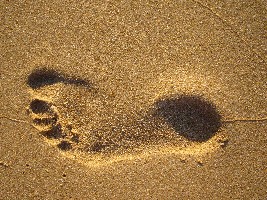
Feeling tired and with a more intense midday Sun than I'd legislated for due to the sun, without the motivation of an upcoming race, I just couldn't get into it. So I opted to walk along the shore and take in the air instead. Kicking off the trainers, it was gorgeous to feel the sea lap my feet.

Needless to say, I got my mojo back after a while and I gave some barefoot running a go. Along the compact wet sand I ran just half a mile, but enjoyed it much more than the previous 4. The Riley gets into town on Saturday so I'm going to do a morning barefoot run on Sunday. This time doing the full length of the shore. Though 5 to 10k doesn't sound much, having not run barefoot much before, I'm anticipating it will be a tough (and slow) one.

Take home lesson for me. Don't run in the midday sun when tired. Going swimming was lush though. It woke me from my slumber. Even though its October, the sea here is lovely to swim in still. Tomorrow will be a different proposition entirely. Going to get plenty of rest and get up early for a  tough hill and tempo run in the hills where my folks live overlooking the sea. I'll make sure I've got my game head on for that.

Thursday, 25 October 2012

The 30 day challenge - Day 20. The chimp paradox

Dr Steve Peters - Sport Psychiatrist
I've been meaning to write about Steve Peter's book, 'The Chimp Paradox', for over a couple of months now. When I was thinking of what to write for today's entry, I realised I'd got this at the end of my list of posts I want to put online, but had neglected it. What a mistake.

As someone working on the mental side of performance, one of the highlights from this years Olympics, was the fact so many Sport Psychologists and mental skills trainers got airtime on radio and TV during Team GB's amazing success. Not only that, but I felt a sea change in that they were considered 'normal' by the audience as part of the multidisciplinary team that surrounds elite level performers. As sport has become ever more professional across the board since the 1980s; fans from sports as diverse as rugby, football, motor racing, athletics and golf have gotten more used to nutritionists, strength and conditioning experts and psychologists - amongst others appearing as part of professional sport. These have all helped individuals and teams set ever faster times, personal bests and winning performances.

But if you asked me as a trainee practitioner (one in their 7th year of professional development I'll grant you!), who is the sport psychologists sport psychologist, I'd personally say "Steve Peters." And I'd have to correct you that he isn't even a psychologist! He's a qualified psychiatrist, who happens to work in sport.

In terms of his achievements, working in conjunction with the awesome Dave Brailsford, and the rest of UK cycling, he's made a massive impact on those who've worked with him. For different reasons, both Sir Chris Hoy and Victoria Pendleton contribute large parts of their success down to the good Doctor. What I like about their views of the man though, is that they would say he hasn't just improved them as athletes - and therefore winners, but that he has followed the same kind of professional care and philosophy as I subscribe to. That is to help try to help improve them as people.

This is an important point. For a lot of people trying to get into our field, if asked about what their purpose is, would probably to say to help improve athlete performance, and start off with finding out what an individual's problem is and try going about fixing that. What the likes of Peters do, is to look at the whole person and see how they can help that individual become a better person and in so doing, obtain the best out of themselves.

I don't have the space here to outline what techniques Steve uses, or why the athletes that he works with require his services, but this article by him on UK cycling's website gives you the fuller picture. Fundamentally, his method relies on an individual understanding themselves better and getting a handle on managing their emotions. Some require a little help, some a lot. But having read the chimp paradox and its methods (there isn't any sport specific advice before you dive off looking for any!), I can say that it is more a book for life, for everyone.

As someone in the field with training across the different types of psychology (cognitive behavioural, humanistic, psychoanalytic, etc), I can understand and can see the approach Steve has taken in explaining quite complex neurological and psychological concepts, and putting them in to plain English for anyone who is a lay reader. As it is his approach is cognitive behavioural, but his care through the writing as a reader has the qualities of a humanistic 'holistic' practitioner.

By this what I mean is that he gets you to look at your whole emotional and mental life and explains how the brain works so that you can implement strategies to manage the best and worst aspects of your character. There's no revolutionary change that you are asked to go through. The main premise of the book is that you have 2 brains in (almost) constant daily conflict. Your 'new' rational human brain, and your 'old' emotional chimp brain. Whilst as a person you may have quite sound rational thought, through evolution, you still have your old monkey brain which has a habit of giving you those dark thoughts; those doubts about your ability which disrupt you from achieving what you are fully capable of. One of the key things to get the best out of this book, is that you have to buy into this premise and work with the book through a number of scenarios. Once over the acceptance of the concept, the idea is that you will get a better grasp of yourself and thus your emotions and ultimately your life. Heavy going this sounds I know, but with regard to sport, I could see the immediate benefits for more low level aspects of performance, e.g. accepting your limitations, being kinder to yourself in training and understanding what is possible, whilst simultaneously pushing your own limits.

To anyone who wants to understand themselves in relation to performance and to subsequently push themselves, I advocate giving this book at try. If you want to 'train your brain', you first need to know how it functions and then build from there. I'll try and write more specifically on this approach around endurance once I've gotten past this 30 day challenge. In the meantime, I thoroughly recommend reading the paradox. I'd even go so far as to say I've seen the benefit of its advice in other areas of my life beyond sport. Not a bad recommend for someone who cares for others mental well being!

Tuesday, 23 October 2012

The 30 day challenge - Day 19. Steve Way.

A short post this afternoon given what I have to get on with study wise for the rest of the afternoon and evening. Was wondering what to write about and was reminded of a gentleman I spoke to Simon Freeman about when we caught up last week. As ever when he and I get together, we try to fit about 10 conversations into 1, cover our respective running, how our girlfriends are keeping and what daft plans we've both got next.

I'd spotted that Steve Way, another running blogger, had been putting up his training stats 'for a big race' he had upcoming and I asked Simon whether this was Amsterdam. It wasn't, for Steve had the IAU World 50Km Trophy to run in Italy. Simon reminded me that my own club mate and former blog interviewee, Paul Martelletti was running it as well.

For those who don't  know who Steve is, he explains well on his blog of his former life, overweight, a smoker and fond of a drink or two and now runs sub 2:20 marathons. I've never met Steve personally, but he did pass me at the Bristol half marathon last month, as he looked very comfortable near the front of the pack and I was en route to a satisfying, albeit slightly painful PB. Whenever I've read his tweets or blog posts, I've always been impressed. Simon vouched for his all round cheerful and friendly persona - he was talked about when Simon and I were saying how much we preferred positive, encouraging runners - so I looked forward to his result this Sunday with interest.

And I was pleased to see that he went and won the damn race! I recommend you read his account. So today - I salute Mr Way (and congratulate Mr Martelletti for an impressive 3rd place as well), and will spend the rest of this afternoon on a hard tempo session, admittedly of speed reading and revising!

As ever, I try and fulfil some sport psych/coaching advice in each post I leave you with. I read through the comments on Steve's 'About' page, and pleasingly found some sound advice that I thought neatly encapsulated his determination and hope it inspires any of the athletes reading this in those moments when you think about skipping a training session:

"the truth is I do still treat myself every now and then. When I’m not in the key 3-4 month build up phase before a target marathon I don’t worry too much about my diet, have the odd drink (although to be honest not really a drinker these days anyway) and I even treat myself to the odd cigar (monthly poker night!)
I find it quite easy to then “knuckle down” in the key phase before my target marathon because all thoughts are on getting the best out of myself for the big day.
The one thing I do all year round though is not have any “Can’t not be arsed” moments with my training, doesn’t matter how much I don’t feel like going for a run I always try and remember how depressed I get when I can’t run due to injury which normally gets me out the door. I also remind myself how good I feel when the miles are in the bag and the session is done. :-) "


Hope you have a good rest of today, whatever you're doing and push yourself that little bit further if you need an extra lift.

S

ps. I know I'm a few days behind. Give me the chance to catch up will ya? ;-)

Monday, 22 October 2012

The 30 Day Challenge - Day 18. Keep on moving.

Over half way in to the 30 day challenge and I'm realising how much it takes to write good content on a daily basis! So far I've enjoyed almost every post I've written. I've tried to vary from interview, to guests to insight and I've enjoyed what I've come up with so far. Last week was a particular highlight with 3 great guests. Talking with Adharanand Finn on Running with Kenyans was really insightful and it was challenging to distil what we'd discussed into something with a sport psychology angle. As with my interview with Gilles Peterson on Thursday (which was so much fun to record, edit and write up), I had so much to include in the write up, keeping focused and concise as possible without losing any crucial detail was difficult. Hence why I had to split it across two posts!

Simon Whyatt's post on nutrition for endurance and reviewing the views of Professor Tim Noakes I loved and what buzzed me the most was that even with a lot of knowledge on the topic, I learnt loads from Simon's advice. I hope it was as useful for you.

Overall, last week was the most successful week on the blog - over 500 readers a day and counting.

This week I have to apply the same dedication from the work I've done so far on the blog to my revision for the 'psychology of performance'. I have an exam in a fortnight at the British Psychological Society to complete so I'm going to have to cut back on the amount of copy I can write. Luckily, what I have to learn is both really interesting and relevant to this blog. Fortunately, to help, I've got a couple of guest blogs due to come through this week again. I'm hoping my guests will get their copy to me on time (hint! ;-) about Mental Toughness (something that I started to cover with Carlos Taboas two years ago), and on triathlon. Before the 30 days is out I want to also cover some endurance cycling as that is an area that I'm really interested in.

Unfortunately the subject has taken a lot of a kicking that last couple of weeks due to the Lance Armstrong affair, but I'm hoping with Carlos' help I can re-dress some of the balance of the performance side of the sport by getting some insight from Carlos (an ex pro in Spain) into the psychological skills required for readers.

On my side I'm going to try and do some end of day highlights of the topics I've been revising each day. I'll be putting in some serious hours in the saddle (as it were), but I'll try and help my revision by explaining to readers how their performance anxiety, confidence and motivation can be improved according to the latest scientific evidence I'm reading up on.

Think this is a relevant track to keep me focused this week...


Here's hoping to a good week to all of you.

S